The short version
On the Albury side of the river, restumping or repairing the foundations of a house without raising it is listed in the NSW Codes SEPP as an example of exempt development, which means no development application and no complying development certificate, provided the work meets the standards in the policy. That route is closed if the house is a heritage item or sits inside a heritage conservation area, and Albury has 16 of those. The builder needs a NSW contractor licence once the job passes $5,000 in labour and materials including GST, a written contract from the same figure, and Home Building Compensation cover once it passes $20,000. Underpinning is a different story on both the approval and the licence. This is the New South Wales page; for a house in Wodonga the rules sit on the Victorian page.
Is council approval needed to restump in Albury?
Usually not, but it is the owner's job to check. The State Environmental Planning Policy (Exempt and Complying Development Codes) 2008, the Codes SEPP, has a General Exempt Development Code in Part 2. Subdivision 27 of that code covers minor building alterations to the outside of a building, and clause 2.53 lists the examples. Item (f) is "restumping or repairing structure foundations without increasing the height of the structure". Clause 2.54 sets the standards that go with it: the work must not add new openings or resize existing ones, and must not reduce the fire resistance of the building.
NSW Planning's remedial building work fact sheet from July 2023 adds the two conditions that matter most for a restump. The work must be like for like, and it must not permanently alter the load bearing capacity of the building. New concrete or steel stumps carrying the same bearers at the same floor height are a like for like repair. Clause 1.16 of the policy also requires the work to meet the deemed-to-satisfy provisions of the Building Code of Australia. The department's 2024 update to the codes kept the same approach: minor building alterations as exempt development include remedial work to repair or maintain a building.
Albury City Council's own exempt development page says the same from the council's end. Minor works need no approval if they meet the state's exempt development standards, and it is the owner's responsibility to check that they do. The council does not inspect or sign off exempt work.
Two things take a job out of the exempt route straight away. Raising the house, even by a few hundred millimetres for clearance, is not restumping under clause 2.53(f) because it increases the height of the structure, and it becomes a planning matter. And any address that is a heritage item or inside a heritage conservation area is outside the exempt codes entirely, which is the next section.
Heritage in Albury: where the exempt route is closed
The remedial work fact sheet is plain about it: exempt development does not apply to a heritage item, a draft heritage item, a heritage conservation area or a draft conservation area. Clause 1.16(1)(c) of the Codes SEPP also excludes land on the State Heritage Register. The Albury Local Environmental Plan 2010 lists 245 local heritage items, 12 state heritage items and 16 heritage conservation areas. The conservation areas are the C1-1 to C1-7 precincts (Albury High School, Crisp Street, David Street North, George Street, Guinea Street, Jones Street and Wyse Street), C3 Bungambrawatha, C4 St David's, C5 David Street, C6 Dean Street, C7 Forrest Hill, C8 Hanel Street, C9 Kenilworth Street, C10 Monument Parklands, C11 Mount Street, C12 St Patrick's, C14 South Albury, C15 Swift Street and C16 Holmwood Cross.
Three of them hold exactly the housing that gets restumped. The council's statement for Swift Street C15 describes late Victorian brick terraces of the 1890s. South Albury C14 is the original town core on the floodplain, with 1870s to 1890s workers' cottages, mostly red brick, some weatherboard described as suffering from neglect. Mount Street C11 is 1920s to 1960s red brick bungalows. A cottage on timber stumps in any of these cannot use clause 2.53(f).
What applies instead: the council's exempt development page says minor works to a heritage item or in a conservation area may need approval through an application under clause 5.10(3) of the Albury LEP 2010. This site has not read the clause itself and does not quote it. The council adopted a Heritage Strategy and Review on 27 July 2026 with amendments to Schedule 5 of the LEP and Part 7 of the Albury DCP 2010 to follow, so the list may change. Check the address with the council before assuming either way.
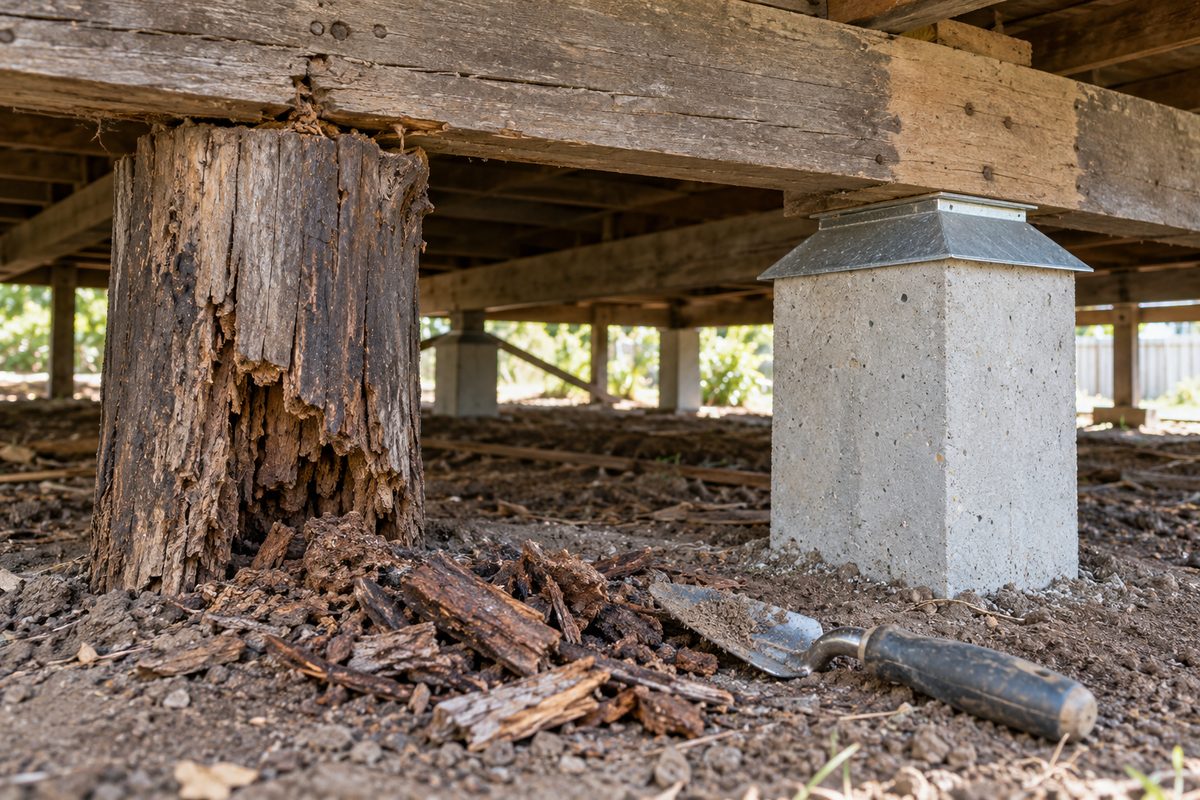
Underpinning and the exempt codes
Underpinning is not named in the Codes SEPP text this site has read. Clause 2.53(f) says "restumping or repairing structure foundations", and a mass concrete pad under a strip footing is a repair to a foundation, but the fact sheet's condition that the work must not permanently alter the load bearing capacity is one an engineer has to answer. Swaab's note on remedial work puts the test as whether the work reinstates a structural element to its intended capacity, in which case it can still be exempt. Subdivision 15 of the code, covering earthworks, retaining walls and structural supports, does not mention underpinning either, does not apply on a heritage item and is limited to the rear yard in a conservation area, as the Planning Portal sets out.
The position this site takes: restumping and repairing foundations without raising the house are listed exempt examples; whether a given underpinning job qualifies is for the engineer and the certifier or council. No complying development pathway is written for restumping or underpinning, so work that is not exempt goes to a development application, or to a clause 5.10(3) application for heritage minor works. After a declared natural disaster, NSW Planning's disaster repair exemption allows certain repair work within two years of the declaration, worth knowing for a house on the South Albury floodplain after a Murray flood.
The licence
The Home Building Act 1989 requires a NSW contractor licence for residential building work worth more than $5,000 in labour and materials including GST, and residential building work includes repairing and renovating a dwelling. The penalty for contracting without one is $22,000 for an individual and $110,000 for a company. "Restumping" is not a named category on the NSW list of building and trade licences; it falls under general building work, so the restumper should hold a general building licence, or be supervised by someone who does, once the job is over $5,000.
Underpinning and piering is its own category over the same $5,000. The NSW Government defines underpinning as constructing a new support structure under a wall, column or footings, and piering as putting in a column or post to support a superstructure, and names RII31220 Certificate III in Civil Foundations as the qualification. So the licence a builder shows you for a stump-and-bearer restump may not cover a strip footing underpin, and the reverse. Ask for the licence number and check it on the NSW licence verification service, where the categories are listed. A Victorian builder can work in Albury through mutual recognition, which the border page covers, but still needs NSW coverage for the job.
Contracts and Home Building Compensation
| Job value (incl GST) | What applies | Source |
|---|---|---|
| Over $5,000 | NSW contractor licence under the Home Building Act 1989. Restumping sits under general building work; underpinning and piering is a separate category. Penalties $22,000 individual, $110,000 company. | NSW Government |
| $5,000 to $20,000 | A written small job contract: the parties, the licence number, the work and the price, signed before work starts. | NSW Government, home building contracts |
| Over $20,000 | A written large job contract meeting the 17-item checklist, including the note about the Home Building Compensation certificate. | NSW Government, home building contracts |
| Over $20,000 | Home Building Compensation cover of at least $340,000, in place before work starts or any deposit is taken. The certificate is yours to keep. | Service NSW |
The NSW Government's page on home building contracts draws the lines. Over $5,000 the contract must be in writing; between $5,000 and $20,000 it is a small job contract, and over $20,000 a large job contract with the 17 items the checklist requires. Service NSW's guide to Home Building Compensation cover says the cover must be at least $340,000 and must be in place before work starts or any deposit is taken on a job over $20,000. A restump quoted just under $20,000 that grows once the bearers are opened up has crossed both the contract and the insurance line, and the quote should say how that is handled.
Flood, soil and the things nobody signs
The Albury Floodplain Management Plan on the NSW SES flood data site covers the whole City of Albury, with Bungambrawatha Creek, Eight Mile Creek and parts of Lavington on the Murray floodplain alongside South Albury, and a 2024 Murray River flood study supersedes the earlier ones and records the South Albury levee upgrade to the 1 per cent annual exceedance level. Restumping that keeps the floor at the same height is unlikely to trigger the flood planning controls. Raising a house on the floodplain is a planning matter, and the DCP's Part 6 on planning for hazards and its flood planning area map are where the council starts. Check the flood planning map before anyone talks about lifting the floor.
Nobody in the approval chain classifies the soil. Soil reports we have seen for two Wodonga-side estates classify the sites as Class M under AS 2870, but no Albury-side report has come our way and this site does not state a class for any New South Wales address; a geotechnical test does that. The National Construction Code's termite risk management provisions apply where termites present a potential risk, and no Albury council termite requirement was found beyond that, so ant caps and durable stumps are good practice and the engineer's specification rather than a council rule.
What happens in what order
- Heritage check. Is the address a heritage item or inside one of the 16 conservation areas? If yes, the exempt route is closed and the conversation starts with the council and clause 5.10(3).
- Inspection and quote. The restumper goes under the house, produces a stump count and a view on the bearers, and confirms the work is like for like at the same floor height. The cost guide says what the quote should name.
- Licence check. The number on the quote is checked on the NSW register, with the right category: general building for stumps, underpinning and piering for footings.
- Contract. Written over $5,000; a large job contract over $20,000.
- Home Building Compensation. Over $20,000, the certificate arrives before any deposit is paid.
- Work, photos, records. Exempt work has no approval attached to it, so keep your own record. Subfloor photos before and after, any engineer's letter and the contract go in the house file for the next buyer.
What exempt development cannot do
It cannot be claimed for a house that is a heritage item, inside a conservation area or on the State Heritage Register; those addresses need the council. It cannot cover raising the house, because that increases the height of the structure, nor new or enlarged openings, nor work that permanently changes the load bearing capacity. It cannot tell an engineer whether an underpin is a repair or an upgrade. It does not replace the licence, which applies from $5,000 whether or not the work is exempt, and it does not replace the contract or the insurance. And it cannot be checked by anyone but the owner: Albury City Council says plainly that the owner is responsible for confirming the standards are met.
Check the current rules before you rely on this
This page describes how restumping and underpinning are approved and licensed on the New South Wales side of the border for Albury home owners. It describes the rules in general terms as they stood in October 2026. Standards, forms, thresholds and fines change.
The authoritative sources are State Environmental Planning Policy (Exempt and Complying Development Codes) 2008, NSW Planning, remedial building work fact sheet, Albury City Council, exempt development, Albury City Council, heritage review, NSW Government, general building work licence and NSW Government, home building contracts. Where anything here differs from those sources, they are right and we are not.
We are not certifiers, building surveyors, engineers, planners or lawyers. For what applies to your house, ask a licensed builder, a certifier or building surveyor, or your council (City of Wodonga on 02 6022 9300 or Albury City Council).
Accurate at the time of writing, October 2026. Always check the source before relying on it.