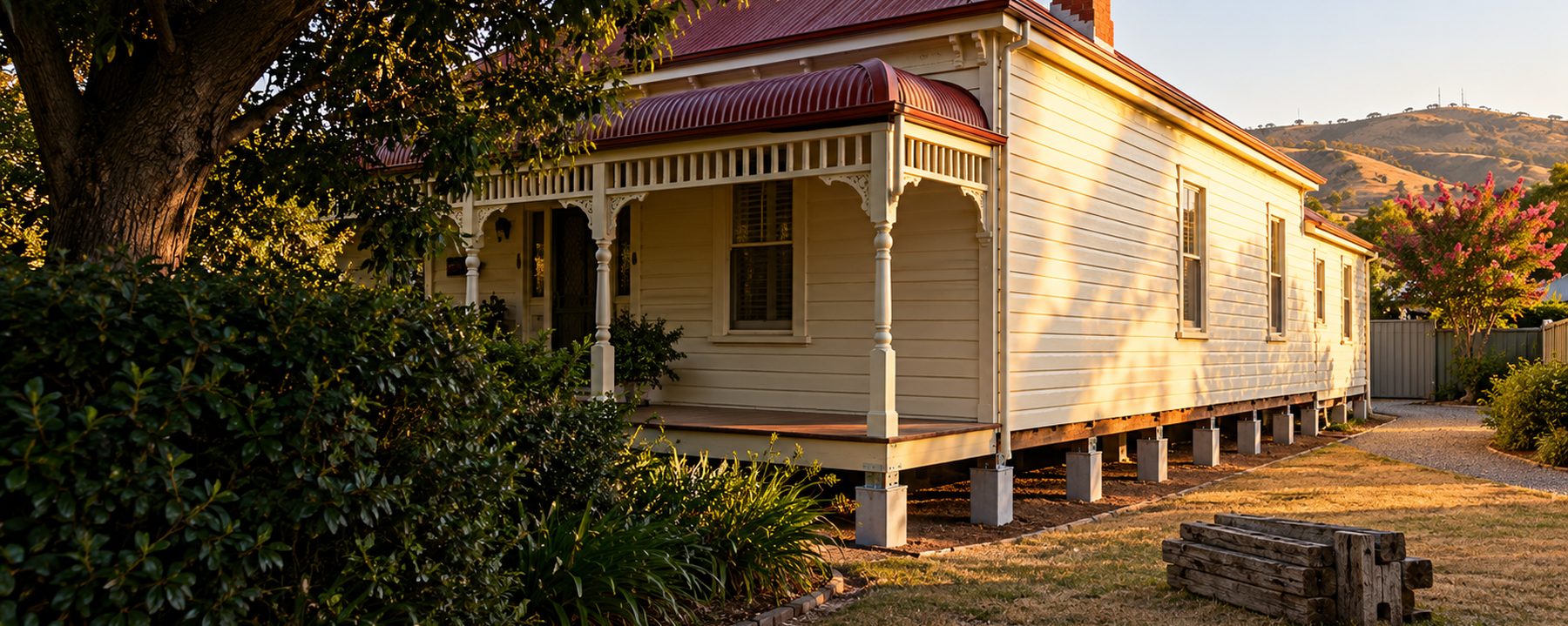
Restumping and reblocking in Albury and Wodonga for houses that have gone off level.
Restumping, relevelling and underpinning for the brick cottages, weatherboards and brick veneers from central Albury and Lavington across the river to Wodonga, Baranduda and out to Thurgoona.
Licensed and registered local builders, the right paperwork for whichever side of the Murray the house is on, and stumps set for clay that opens in late summer and closes after the winter rain.
Tell us what the house is doing
The town, which side of the river it is on, what the house sits on if you know, and what you have noticed: a hallway that runs downhill toward the back of the house, a door that catches at the top, a crack over a window that opened in February and has not closed. A photo of the worst room and one of the outside at ground level is enough to begin with. If you can get a torch under the floor, a photo of a stump or two tells us most of the rest.
If the house is being sold, a building or pest report has flagged the stumps, or a renovation is waiting on a level floor, say so. It changes what gets lodged first, and on the border it changes which regulator the paperwork goes to.
Request a quote
One river, two sets of rules, and the same clay under both.
Central Albury is mostly late-Victorian and interwar brick cottages and bungalows, with a minority of weatherboard cottages, and many of them sit on timber stumps or brick piers over a subfloor nobody has crawled into for decades. Lavington took much of Albury's growth from the 1950s to the 1970s, especially after the Albury-Wodonga Development Corporation arrived in the early 1970s. Across the river, Wodonga grew from a town of about 3,000 people in 1947 to more than 31,000 by 2011, with the growth centre decision of 1973 and the Housing Commission estates filling in the 1960s to 1980s housing, commonly brick veneer. The newer estates at Killara, Riverside, Silky Oaks and Thurgoona are slab on ground on clay, where the problem is slab heave and the answer is piering or resin rather than a new stump.
Under all of it is reactive clay. Soil reports we have seen for two Wodonga-side estates classify the sites as Class M under AS 2870, one of them M-D, with stumps and piers required at least 500 to 600 mm below the surface. Hot dry summers and cold wet winters work that clay every year. Timber stumps rot or get eaten at ground level, the bearer above drops, and the house follows: the floor tilts, the doors bind, the plaster cracks from the corner of the frame to the cornice.
Restumping, or reblocking as Victorians call it, replaces those stumps with concrete or galvanised steel and brings the floor back to level on the way. What the job needs on paper depends on which bank of the Murray the house stands on. In New South Wales it is a licence over $5,000, a written contract at the same figure, and an approval route that is often exempt development unless the house is heritage listed or in a conservation area. In Victoria it is a building permit from a registered building surveyor, a builder registered with the Building and Plumbing Commission at any job value, and a written contract over $10,000. The pages here cover both halves, the trade and the rules, for each side.
What changes when the job crosses the river, in plain English
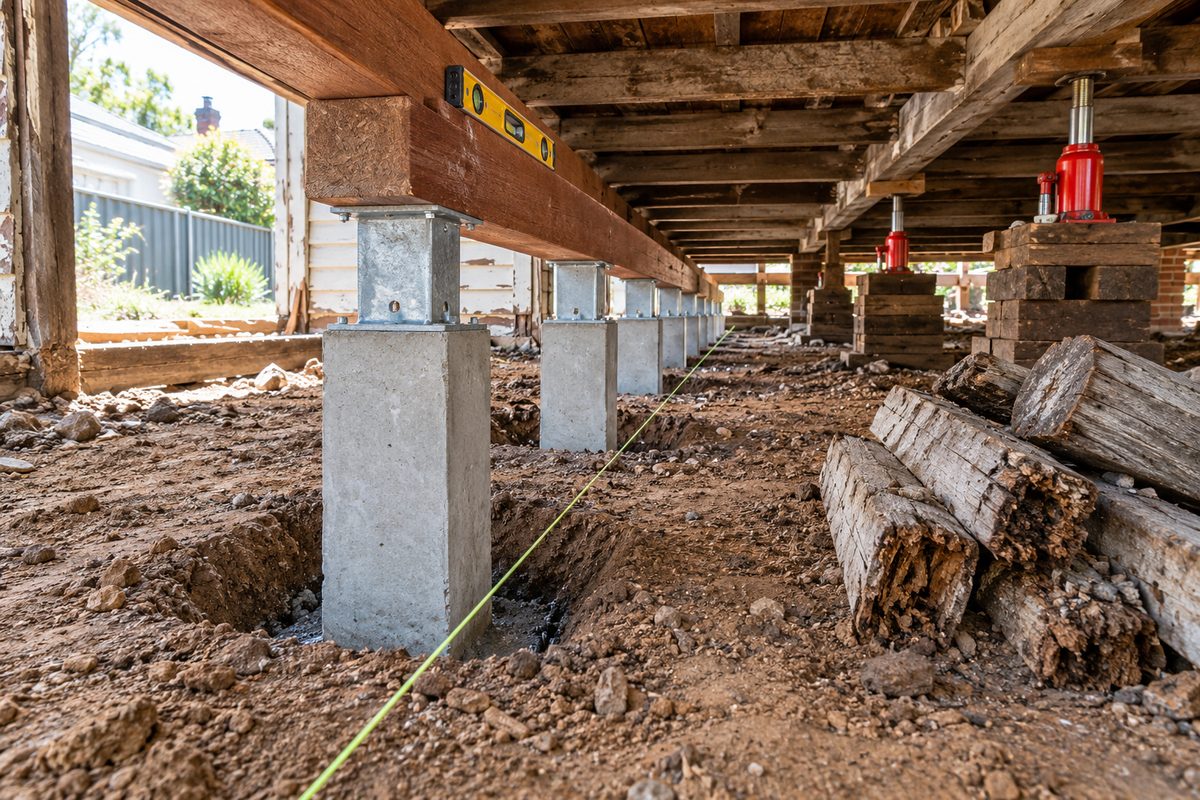
Eight ways a border house asks for new stumps
Most of them show up inside long before anyone looks underneath, and on reactive clay several of them come and go with the seasons.
- The floor runs downhillA marble rolls to the same wall in every room. In a South Albury cottage the hallway tips toward the wet end of the house, where the ground stays damp longest and the stumps go first.
- Doors that need a shoulderThe back door shut fine in winter and has to be lifted to close by March. The frame has gone out of square because the stump under that corner has dropped or the clay under it has shrunk.
- Cracks that open in summer and close in winterDiagonal cracks in the plaster from the top corner of a door or window to the cornice. On Class M clay they open late in a dry summer and close after the winter rain, which is why a crack that comes and goes is still worth a look.
- A gap under the skirtingThe skirting stays where the wall is and the floor drops away from it. Daylight under a skirting in a Lavington weatherboard is a stump, not a carpenter.
- A building report said soA pre-purchase inspection on a house in East Albury or West Wodonga found rotted stumps, a bearer packed up on offcuts or a crushed stump top, and the sale is waiting on a price to fix it.
- The pest inspector found themTermite-eaten timber stumps are a standard reason for restumping in the region. The National Construction Code asks for termite management where termites present a potential risk, and a pest report that finds galleries in the stumps usually finds them in the bearers too.
- A renovation is waitingThe builder will not put a new kitchen or a second storey on a floor that is not level, and on the Wodonga side the building surveyor will not sign off an extension on stumps that have failed.
- The brick house is crackingA 1970s brick veneer in Wodonga or a slab home in Thurgoona with a stepped crack through the mortar above a window. That is footings or slab moving on clay, not stumps, and it is underpinning rather than restumping.
Restumping and underpinning services in Albury and Wodonga
Each page explains what the work involves, which state's rules apply to it, and what tends to drive the price.
Restumping Albury
Replacing failed timber stumps under a whole house on the New South Wales side, with the licence, contract and approval rules that go with it.
Read more →Reblocking Wodonga
The Victorian side: building permit, registered builder at any job value and Home Warranty insurance for reblocking and restumping.
Read more →Underpinning
Stabilising brick, brick veneer and slab homes whose footings have moved on reactive border clay.
Read more →House relevelling
Jacking and packing a house that has sagged on stumps that are still sound, without a full restump.
Read more →Subfloor repairs
Stumps, bearers, joists and termite-damaged timber replaced while the floor is open.
Read more →What it costs
What moves the price of a restump on the border, from stump count and clearance to the paperwork each state adds, and what a quote should spell out.
Read more →Why restumping here is its own job
Four things about this stretch of the Murray decide how long stumps last, what should replace them, and who has to sign the paperwork.
The ground. Soil reports we have seen for two Wodonga-side estates classify the sites as Class M under AS 2870. A Killara report for a lot in Riverside Estate came back Class M-D, moderately reactive and deep, in silty and sandy clays, with surface movement of 20 to 40 mm and stumps or piers to go at least 600 mm below the surface. A Silky Oaks Estate report in Wodonga came back Class M in sandy clays of medium to high plasticity, with stumps and piers at least 500 mm down and an allowable bearing pressure of 100 kPa from 300 mm. No published report for the Albury side has come our way, so this site does not state a class for any New South Wales address. The class of your site is set by a geotechnical test, not by the house next door.
The seasons. The Bureau of Meteorology's Albury Airport station averages 639.2 mm of rain a year over the record since 1994, with a mean January maximum of 32.5 C, a mean July maximum of 13.3 C and a mean July minimum of 3.1 C. Hot dry summers and cold winters mean the clay shrinks and cracks open in late summer, then swells and closes after the winter rain. A house on stumps rides that cycle every year, and the stumps in the wettest corner of the subfloor ride it worst.
The housing. Three of Albury's heritage conservation areas tell the story of the older stock: Swift Street with its late Victorian brick terraces from the 1890s, South Albury with 1870s to 1890s workers' cottages, mostly red brick with some weatherboard described as suffering from neglect, on the original town core on the floodplain, and Mount Street with 1920s to 1960s red brick bungalows. Lavington had 13,073 people at the 2021 census and much of it is 1950s to 1970s housing. Wodonga was 7,789 people in 1961 and 18,142 by 1981, so a large share of its stock is 1960s to 1980s housing, commonly brick veneer. The newest estates on both sides are slabs on clay, where the question is heave and piering rather than stumps and bearers.
The river. Cross it and the regulator changes from Building Commission NSW to the Building and Plumbing Commission, the licence trigger changes from $5,000 to registration at any value, the contract trigger from $5,000 to $10,000, the insurance from Home Building Compensation to Home Warranty, and the approval route from often exempt to a building permit on every job. Add that the whole City of Albury sits under a floodplain management plan and that Wodonga's 1 per cent flood land shows up as planning overlays, and the paperwork here is rarely just the stumps.
Practical consequence: the cheapest quote on paper is usually the one that has not looked at the bearers, has not asked which state the house is in or whether it is in a conservation area, and is putting untreated timber back into clay that has just finished with the last lot.
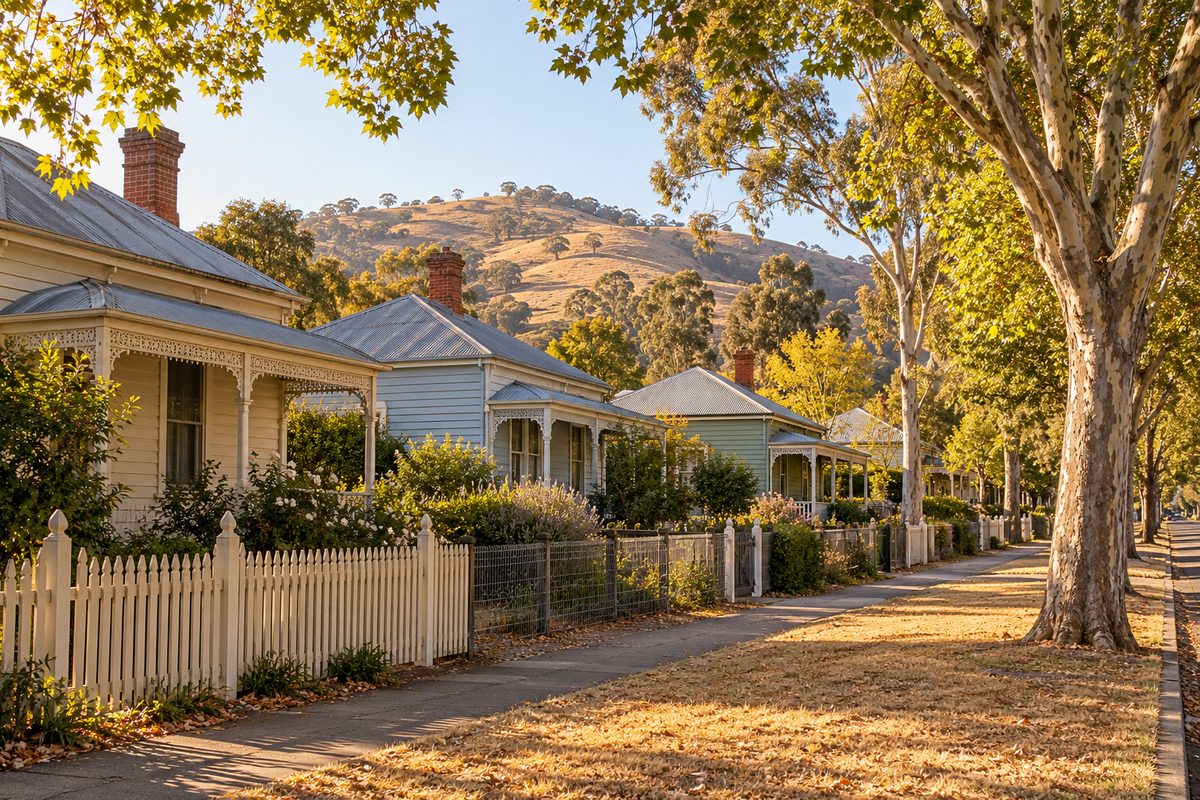
Towns and suburbs covered:
What happens on a border restump
Six steps. The first three happen before anyone crawls under the house with a jack, and step three is where the side of the river matters most.
Photos, the town and a look underneath
What the house is doing inside, what it sits on, and which state it is in. A subfloor inspection with a torch, a probe and a long level finds which stumps have gone and whether the bearers and joists above them are still sound. A price range follows.
Quote, contract and insurance
A written quote naming the stump count, the stump type, the levelling, any bearer or joist work and the approval. In NSW a job over $5,000 needs a written contract and over $20,000 needs Home Building Compensation cover before any deposit. In Victoria it is a major domestic building contract over $10,000 and Home Warranty insurance over $20,000.
Approval, by state
Albury side: a heritage check on the address, then either the exempt development standards or an application. Wodonga side: a registered building surveyor checks the overlays and issues the building permit, and the council's Road Reserve Works Permit is applied for if the works touch the road reserve.
Jack, dig, set
Baseboards come off. The house is lifted a few millimetres at a time on jacks, old stumps are cut out, new holes are dug to the depth the engineer or the permit drawings call for, and concrete or galvanised steel stumps are set plumb on a string line with ant caps on top.
Level and pack
A laser level runs the bearers back to true. Steel shims or adjustable heads take up the last few millimetres. Rotted or termite-eaten bearers and joists found on the way are replaced while the floor is accessible.
Vents, drainage, sign-off
Subfloor vents go back in or get added, the ground under the house is graded so water runs out rather than in, baseboards go back on. On the Wodonga side the building surveyor's final inspection closes the permit; on the Albury side the contract and the photos are the record.
Two regulators, two licence triggers, two approval routes
On the Albury side the Home Building Act 1989 requires a NSW contractor licence for residential building work over $5,000 in labour and materials including GST, and the penalties for working without one are $22,000 for an individual and $110,000 for a company. Restumping is not a named licence category and falls under general building work; underpinning and piering is its own category over the same figure. A written contract is needed over $5,000, a large job contract over $20,000, and Home Building Compensation cover of at least $340,000 over $20,000, in place before work starts or any deposit is taken. For approval, the Codes SEPP lists restumping or repairing structure foundations without increasing the height of the structure as an example of exempt development, subject to its standards, but not on a heritage item or in one of Albury's 16 heritage conservation areas.
On the Wodonga side restumping and reblocking are building work under the Building Act 1993. The Building and Plumbing Commission's practice note on when a permit is required excludes underpinning or replacement of footings from the repair exemption, and City of Wodonga's permit table lists reblocking or restumping of an existing building. The builder must be registered with the Commission regardless of the value of the work; the general $10,000 threshold does not apply to restumping. Over $10,000 the job needs a written major domestic building contract, and from 1 July 2026 the builder takes out Home Warranty insurance where the work costs more than $20,000.
A builder licensed on one side can work on the other through Automatic Mutual Recognition, for individual licences only and with a notification to the other regulator before starting, but the rules of the state the house is in still govern the contract, the insurance and the approval. Check both registers.
Approvals and licences on the Albury side · Permits and registration on the Wodonga side
What a restumper cannot fix
A restumper cannot make reactive clay stop moving, cannot stop water pooling under a house where a downpipe has been discharging onto the ground for twenty years, and cannot issue a Victorian building permit, because that is the building surveyor's job. A restumper cannot tell you from the street whether the bearers are sound, cannot say whether an Albury address sits inside a heritage conservation area, cannot stop termites coming back to a house with no management in place, and cannot promise a brick veneer or a slab home will stop cracking, because that is footings and an engineer, not stumps. Those belong to the drainer, the surveyor or certifier, the council, the pest controller and the engineer.
Check the current rules before you rely on this
This page summarises how restumping is licensed and approved on both sides of the Albury-Wodonga border. It describes the rules in general terms as they stood in October 2026. Standards, forms, thresholds and fines change.
The authoritative sources are NSW Government, general building work licence, NSW Planning, remedial building work fact sheet, Albury City Council, exempt development, Building and Plumbing Commission, practice note BP-01, when is a building permit required, City of Wodonga, do I need a building permit and Victorian Building Authority, clarification of registration requirements for domestic builders. Where anything here differs from those sources, they are right and we are not.
We are not certifiers, building surveyors, engineers, planners or lawyers. For what applies to your house, ask a licensed builder, a certifier or building surveyor, or your council (City of Wodonga on 02 6022 9300 or Albury City Council).
Accurate at the time of writing, October 2026. Always check the source before relying on it.
What moves the price of a restump
Restumping is priced per stump and then adjusted for everything that makes a stump harder to reach or more likely to be joined by other work. On the border the state of the bearers and the depth the clay demands move the number more than the size of the house does, and the paperwork for the side of the river the house is on comes a close third.
| Factor | Why it matters |
|---|---|
| Stump count | A small South Albury cottage on a tight stump grid can carry more stumps than a bigger 1960s Wodonga house on bearers at wider centres. The count sets the base. |
| Clearance | A weatherboard 250 mm off the ground in Lavington is dug by hand lying down. A house 700 mm up on a sloping block above the river is a different day's work. |
| Stump type | Precast concrete is the common choice. Galvanised adjustable steel is priced separately and can be relevelled later with a spanner, which matters on clay that keeps moving. |
| Ground and depth | The Wodonga-side soil reports we have seen call for stumps at least 500 to 600 mm below the surface. Dry clay in March digs like rock; wet clay in August sticks to everything. The engineer or the surveyor sets the depth for your site. |
| Bearers and joists | Rotted or termite-eaten timber above the stumps is replaced while the floor is up. In an older house with blocked vents it is often the bigger line. |
| State paperwork | Wodonga side: the building surveyor's permit fee and any Road Reserve Works Permit. Albury side: usually nothing for exempt work, but a heritage application if the house is in a conservation area. Ask the surveyor or the council for the current figure. |
| Access | Can a small machine get down the side of the house, or does every barrow of spoil go out through the gate by hand to a trailer on the street. |
| Drainage | Vents, an agricultural drain and regrading under the house, so the new stumps do not sit in the water the old ones failed in. |
When you compare quotes, check whether each one names the number of stumps and their type, says which state's contract it is written under, includes the building permit if the house is in Victoria, and says what happens if bearers are found to be rotten once the floor is open.
Things border home owners ask
Do I need council approval to restump a house in Albury?
Often not, but check. The NSW Codes SEPP lists restumping or repairing structure foundations without increasing the height of the structure as an example of exempt development, provided the work is like for like, does not add or resize openings and does not permanently alter the load bearing capacity. Exempt development does not apply to a heritage item or inside a heritage conservation area, and Albury has 16 of those, so a heritage check on the address comes first. Raising the house is not restumping and is a planning matter.
Do I need a building permit to reblock a house in Wodonga?
Yes. Reblocking and restumping are building work under Victoria's Building Act 1993, and the repair exemption in the regulations does not cover underpinning or replacement of footings. City of Wodonga's own permit table lists reblocking or restumping of an existing building as needing a permit, and most works also need a Road Reserve Works Permit. The permit comes from a registered building surveyor, and the builder must be registered with the Building and Plumbing Commission whatever the job is worth.
Does the builder have to be licensed or registered?
On the Albury side, residential building work over $5,000 in labour and materials including GST needs a NSW contractor licence under the Home Building Act 1989, with penalties of $22,000 for an individual and $110,000 for a company. On the Wodonga side, a builder must be registered with the Building and Plumbing Commission to restump or reblock a home regardless of the value of the work. Check the licence on the NSW verification service or the Victorian practitioner register before you sign.
How do I know if the house needs restumping or just relevelling?
By the stumps, not the floor. Sloping floors, sticking doors and diagonal cracks above door frames say the house has moved. Whether it needs new stumps or can be jacked and packed on the ones it has depends on whether those stumps are rotted, termite-eaten, leaning or still sound. A subfloor inspection with a torch, a probe and a long level answers that, and it is the first thing worth doing on either side of the river.
Why do border houses move so much?
Clay and weather. Soil reports we have seen for two Wodonga-side estates classify the sites as Class M under AS 2870, one as M-D, with surface movement of 20 to 40 mm on the more reactive one. Albury Airport averages 639.2 mm of rain a year, with hot dry summers and cold winters. Clay like that shrinks through summer and swells after winter rain, so cracks open in late summer and close by spring. Your own site's class comes from a geotechnical test.
What does restumping cost in Albury or Wodonga?
This site does not quote. The price depends on the number of stumps, how high the house sits, the stump type, how far the spoil is carried, whether bearers and joists need replacing while the floor is up, and which side of the river sets the paperwork. In NSW a job over $5,000 needs a written contract and over $20,000 needs Home Building Compensation; in Victoria it is a major domestic building contract over $10,000 and Home Warranty over $20,000. The cost guide explains what moves the number.
Which towns do you cover?
Albury, Lavington, North Albury, South Albury, East Albury, West Albury, Thurgoona on the New South Wales side, with Jindera, Howlong and Corowa further out; Wodonga, West Wodonga, Baranduda, Killara and Bandiana on the Victorian side, with Tallangatta, Beechworth, Yackandandah and Rutherglen in the hills. The town pages cover the housing and the rules for each.
Can one builder work on both sides of the river?
Sometimes. Automatic Mutual Recognition lets a Victorian licence holder work in NSW if the licence covers the work and they notify Building Commission NSW before starting, and Victoria offers the reverse to individual practitioners who lodge the notification first. Individual licences only, not companies. The contract, insurance and approval rules of the state the house is in still apply, so a Wodonga builder in Albury works under NSW contract and HBC rules, and an Albury builder in Wodonga needs a building permit. Check both registers.
Send a few photos and a town
The worst room, the outside of the house at ground level, and if you can get under the floor, a stump or two. Say which side of the river. That is usually enough for a price range before anyone visits.