What restumping in Albury covers
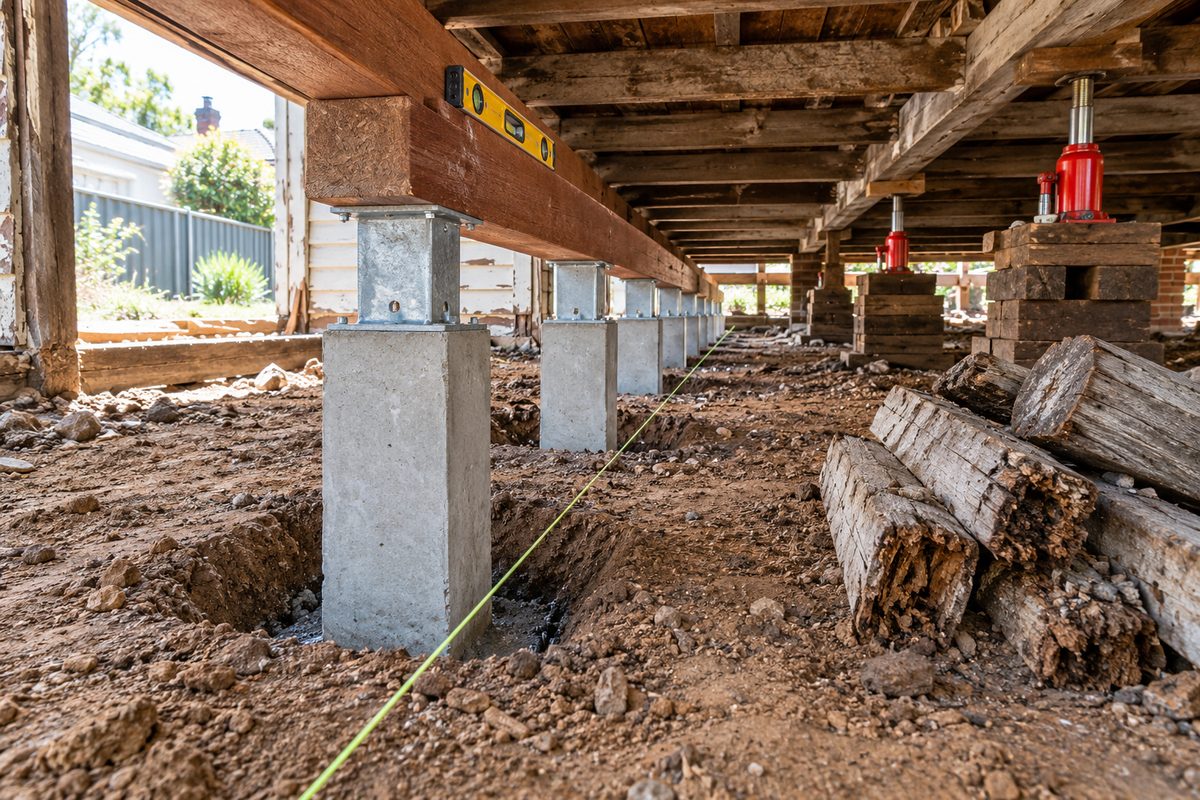
Restumping replaces the stumps under a house: the posts, usually timber in an older home, that carry the bearers and joists under a timber floor. On the New South Wales side of the river the trade calls it restumping, and the job is the same whether the house is a weatherboard cottage near the centre of town or a 1960s house in Lavington. The house is lifted a few millimetres at a time on jacks, the old stumps are cut out and dug up, new holes go down to firm ground, precast concrete or galvanised steel stumps are set plumb to a string line, ant caps go on, and the bearers are packed back to one level on a laser before the baseboards are refitted. A full restump does every stump. A partial one does the stumps the inspection found soft, leaning or eaten, and relevels the rest on what is there.
It also covers paperwork that is different from the Wodonga side. In New South Wales, restumping is residential building work under the Home Building Act 1989, and the licence, contract and insurance rules below switch on at set dollar values. Council approval is often not needed at all, because restumping without raising the house is listed as an example of exempt development, though a heritage listing takes that route away. Each of those points gets its own section below, after the part about the houses themselves.
The Albury houses that get restumped
Central Albury is mostly late-Victorian and interwar brick cottages and bungalows, with a minority of weatherboard cottages, many on timber or brick-pier subfloors. The council's own conservation area statements describe the stock: 1890s brick terraces in the Swift Street area, 1870s to 1890s workers' cottages in South Albury (mostly red brick, some weatherboard, and the statement describes some of the weatherboard as suffering from neglect), and 1920s to 1960s red brick bungalows along Mount Street. Lavington carries much of Albury's expansion, especially after the Albury-Wodonga Development Corporation arrived in the early 1970s, so think of 1950s to 1970s housing there. A brick cottage with a timber floor still stands on stumps or piers under that floor, and a brick bungalow on brick piers can have timber stumps under an enclosed verandah or a later extension, which is where the soft spot usually turns up.
What takes the stumps out is the ground and the weather. The Bureau of Meteorology's Albury Airport record (1994 to 2026) gives a mean annual rainfall of 639.2 mm, a mean January maximum of 32.5 degrees and a mean July minimum of 3.1 degrees. Hot dry summers and cold wet winters: clay opens up in late summer and closes again after the winter rain, and a timber stump standing in a hole that is dry in February and wet in July rots at the ground line. Termite-eaten stumps are the other common reason a house on this side of the river is restumped; the subfloor repairs page covers what happens when the bearers have gone with them.
Licence, contract and insurance: the New South Wales thresholds
Three dollar values decide the paperwork, and all three come from the Home Building Act 1989 rather than from the council. The values are labour and materials together, including GST.
| Value of the job | What is required | Source |
|---|---|---|
| Over $5,000 | A NSW contractor licence. Restumping is not a named licence category; it falls under general building work, which covers repairing and renovating a home. Penalties for unlicensed work are $22,000 for an individual and $110,000 for a company. | General building work licence |
| $5,000 to $20,000 | A written contract. In this range a small job contract is enough. | Home building contracts |
| Over $20,000 | A large job contract with the 17-item checklist, and Home Building Compensation cover of at least $340,000 in place before work starts or any deposit is taken. | Home building compensation cover |
| Any value | A licence check before signing. Ask for the number, then look it up on the NSW licence verification service. | Checking your contractor |
Two things follow for an Albury owner. A restump is rarely under $5,000 once stumps, jacking and levelling are counted, so expect a licensed contractor and a written contract on any job. And whether it crosses $20,000 changes the contract form and brings in HBC cover, so a quote near that line should say which side it falls on. Ask for the licence number and check it yourself on the verification service rather than taking a card at face value. A Victorian registration on its own is not a NSW licence; the border section below says what a Wodonga builder needs before working in Albury.
Council approval: often exempt, but check
The State Environmental Planning Policy (Exempt and Complying Development Codes) 2008 lists, among minor external building alterations at clause 2.53, "restumping or repairing structure foundations without increasing the height of the structure". The NSW Planning remedial building work fact sheet confirms that wording and adds the conditions: the work has to be like for like, it must not permanently alter the load bearing capacity of the building, and the general standards apply, so no new or resized openings and no reduction in fire resistance. A 2024 update to the codes describes minor building alterations as exempt development that includes remedial work to repair or maintain a building. Albury City Council's position is that minor works need no approval if they meet the state exempt standards, and that the owner is responsible for checking.
The exception is heritage. Exempt development does not apply on a heritage item, in a heritage conservation area, or on land on the State Heritage Register. The Albury Local Environmental Plan 2010 lists 245 local heritage items, 12 state heritage items and 16 heritage conservation areas, and the central and South Albury cottages that most often need restumping sit inside several of them: Swift Street (C15), South Albury (C14), Mount Street (C11) and the rest listed in the council's heritage review. Inside one of those the exempt route is off the table, and the council's exempt development page says minor works on a heritage item or in a conservation area may need an application under clause 5.10(3) of the LEP. The council adopted a Heritage Strategy and Review on 27 July 2026, with amendments to LEP Schedule 5 and DCP Part 7 to follow, so the lists are moving; check the current one before assuming anything. The NSW rules page goes through all of this in more depth.
Two more lines to draw. Raising a house is not restumping: the exempt example is tied to not increasing the height of the structure, so lifting a floor higher than it was built is a planning matter, and on the Murray floodplain in South Albury it is a flood planning matter as well. The Albury Floodplain Management Plan covers the whole city, with Bungambrawatha Creek, Eight Mile Creek and Lavington on the floodplain; a 2024 Murray River flood study has replaced the earlier ones, and the South Albury levee has been upgraded to the 1% AEP standard. Restumping that puts the floor back where it was is unlikely to trigger any of that. Check the flood planning map if the house is anywhere near the river, and ask the council if the floor height is going to change.
How an Albury restump runs
- Subfloor inspection. Every stump is probed at the ground line and checked for plumb, the bearers and joists are sighted along their length, termite galleries and moisture are noted, and the floor is levelled through the house. The result is a count of stumps to replace and a view on the timber above them. Ask for photographs with the report.
- Heritage and flood check. Before anyone quotes an approval route, the owner or the builder checks whether the house is a heritage item or inside a conservation area, and whether it sits on the flood planning map. Ten minutes on the council's planning tools saves a job being stopped half way.
- Written quote and contract. Stump count, stump type, depth, levelling, ant caps, what happens if a bearer is soft, and whether the price is over or under $20,000. Over $5,000 the contract is required by law, and over $20,000 it is the large job form with HBC cover attached.
- Licence check. The contractor's licence number is looked up before any deposit is paid. For work over $5,000 it is the law, and it is the one check that cannot be done after the fact.
- On the day. Baseboards come off along the side being worked. Jacks take the load either side of the first stump, the old stump is cut out and dug up, the new hole goes to firm ground in the clay, the new stump is set plumb on the string line with its ant cap, backfilled and rammed, and the bearer comes down onto it. Then the next one. A single-storey house is typically days rather than weeks on site, longer if clearance is tight or bearers have to come out.
- Levelling and finishing. When the stumps are in, the laser goes up and every bearer is brought to one line with steel packers. Vents are refitted, the ground under the house is graded to fall away from the stumps, and the baseboards go back on.
One river, two sets of rules
Everything above is New South Wales. Cross the river to Wodonga and the regulator is the Building and Plumbing Commission rather than Building Commission NSW, the builder has to be registered to reblock a house at any value rather than licensed over $5,000, the written contract trigger is $10,000 rather than $5,000 and $20,000, the insurance is Home Warranty rather than HBC, and the approval is a building permit from a registered building surveyor rather than a usually exempt job. The reblocking Wodonga page is written for that side.
Builders cross the river all the time, and the law allows it with conditions. Under Automatic Mutual Recognition a Victorian licence holder can work in New South Wales if the licence covers the work and they notify Building Commission NSW before starting; it applies to individual licences, not companies. Victoria offers the reverse to individual practitioners with its own notification before starting. For an Albury owner the practical rule is simple: whoever is quoting, check the NSW register, and if the business is from Wodonga ask what NSW coverage it holds. The border page explains the mechanics.
What a restump cannot fix
A restump cannot fix a house that is not on stumps. A brick veneer on a strip footing or a slab home on one of the newer estates that is cracking on reactive clay is a footing problem, which is an engineer and underpinning. It cannot make a soft bearer sound again, which is why the quote has to price that before the baseboards come off. It cannot change the seasons: clay on the border will keep opening in late summer and closing in winter, and deeper stumps with good drainage ride that movement rather than stopping it. And it cannot tell you whether your house is a heritage item or inside one of the 16 conservation areas. The council's planning tools and the certifier do that, and the exempt route depends on the answer.
Check the current rules before you rely on this
This page describes how a house restump is licensed, contracted and approved on the Albury side of the border. It describes the rules in general terms as they stood in October 2026. Standards, forms, thresholds and fines change.
The authoritative sources are NSW Government, general building work licence, NSW Government, home building contracts, Service NSW, home building compensation cover, NSW Planning, remedial building work fact sheet, Albury City Council, exempt development and NSW Government, checking your contractor or tradesperson. Where anything here differs from those sources, they are right and we are not.
We are not certifiers, building surveyors, engineers, planners or lawyers. For what applies to your house, ask a licensed builder, a certifier or building surveyor, or your council (City of Wodonga on 02 6022 9300 or Albury City Council).
Accurate at the time of writing, October 2026. Always check the source before relying on it.